County administrator addresses state audit findings
PROTECTED CONTENT
If you’re a current subscriber, log in below. If you would like to subscribe, please click the subscribe tab above.
Username and Password Help
Please enter your email and we will send you a password reset link.
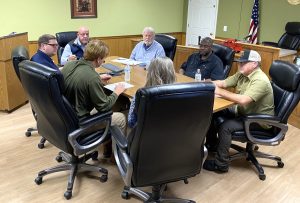
The Randolph County Commission, seen here in a workshop meeting earlier this year, received a report Monday from CFO Travis Heard regarding the most recent audit of the county.
County administrator Travis Heard spoke for about 10 minutes at Monday’s meeting of the Randolph County Commission to address one by one the recently published findings of an audit of the county that was conducted by the Alabama Department of Examiners of Public Accounts.
The auditors’ report revealed five findings from their examination of the county’s records from fiscal years 2022 and 2023.
Audits do not take place annually in smaller counties like Randolph, but the Examiners office does conduct audits of every fiscal year, often covering multiple years in one audit.
“They don’t do an audit every year, but every year is audited,” Heard said.
The most recent audit began in April of last year and resulted in the findings published earlier this month.
1819News.com published a story Monday afternoon on its website spelling out some of the findings from the audit.
But Heard said some of the information presented in that article is misleading. And one of the commission’s biggest points of emphasis Monday was that the findings in the report all stem from ongoing issues that take time to resolve, not ones that were recently uncovered.
“There is no new findings on this. This is all stuff from prior,” said commission chairman Derek Farr. “Just so the public knows that, this is just things that are lingering from the past.”
Commissioner Chris Lunsford echoed that point.
“These are pre-existing, and they don’t go away from an auditor’s perspective until they are completely resolved,” he said.
Here are the five issues or “findings” brought up in the auditors’ report, and Heard’s explanation for them.
No financial statements
Producing comprehensive financial statements for a complex organization like a county government can be a monumental task. The county has not provided financial statements for three consecutive audits that cover the years 2017-2023.
The first year of that stretch coincides with a change in accounting standards that took place in 2016.
“In 2016 the Governmental Accounting Standards Board took a stance of, that the accountants who prepare the financial statements cannot also audit the financial statements. Previously the examiners audited and prepared our financial statements for us,” Heard said. “And since the GASB has taken that stance, that has been an issue for a lot of small counties.”
Until 2023 Heard was the lone member of the county’s financial staff. The county operates and manages over 50 bank accounts, a number necessary to keep specific funds separate and, theoretically, easier to track. However Heard admitted that the task of compiling all of that information into annual statements was simply more than one person could do.
That changed when the county hired Karla Minnefield as finance clerk. She has helped offset the workload for Heard and has helped keep things more organized on a month to month basis, which should make the task of preparing financial statements for future audits more manageable.
“We are working towards getting that cleared up. We should have financial statements for FY ’24,” Heard said. He also indicated that with the procedures that are currently in place, creating financial statements on an annual basis going forward is expected to be the norm.

Disbursement of education sales tax funds
This finding stems from one specific incident in 2020 in which the county incorrectly paid Roanoke City Schools $283,752.88 from the one-cent education sales tax that should have been paid to the Randolph County Board of Education.
Each year the state department of education provides the county with the percentages of how much of those sales tax funds each school system should receive, based on the student enrollment in each system.
“I don’t know what the state department had going on that year,” Heard said. “But we did not receive the letter that sets out the percentages until November, the middle of November.”
In an email to one of the commissioners and shared with the Leader, Heard explained the discrepancy like this: “We received the state BOE’s enrollment numbers in mid-November 2020, instead of September like normal. The change was reported…and they had it corrected by the end of December 2020. Basically, the FY20 education sales tax funds were distributed for 3 months based on the FY19 enrollment numbers.”
Without the numbers from the state, the county was essentially flying blind until those numbers were provided.
Since then the two school systems have entered into a repayment agreement where Roanoke City Schools sends the county school system a monthly check for $7,882.02. This will continue until the full amount is paid off, which will be in October of 2027.
This item will continue to appear as a finding on any future state audit of the county until that repayment plan is complete.
Improper use of capital improvement funds
This is another long-standing finding that originally appeared on the county’s audit in 2015. It is not related to a recent infraction.
“It’s one of those that’s been hanging around since 2015, is when it started,” Heard said. “The commission transferred $509,049.30 to the general fund because, the audit report doesn’t say this, but if I had to give a reason I would feel comfortable in saying it was to pay payroll. Because when I came in 2017 the commission couldn’t make payroll in June.”
It’s not an ongoing issue, but because the full amount of that transfer has not been reimbursed to the capital improvement fund, it remains on the audit.
“We don’t have the payroll issues anymore, but that finding is still hanging around,” Heard said. “And it will continue to hang around until that money is paid back from the general fund to the capital improvement fund.”
Unreconciled bank accounts
Part of this issue stems from a miscommunication when Minnefield was hired as part of the county’s finance team.
Before Minnefield was hired, “I recorded our direct deposit revenues that we get from the state of Alabama. I recorded them as one big giant entry for the whole year,” Heard explained. “And our finance clerk did not realize that, so she started recording them on a monthly basis. So what happened is we double reported revenues. That has since been corrected. But it is still a finding. We now have policies in place to prevent it.”
Heard said that one of those policies includes a monthly account reconciliation that both he and Minnefield review.
Asset listings
This is the longest-standing finding on the report, dating back to 2004.
“In 2004 GASB decided that they wanted all local governments to start keeping track of their fixed assets, and Randolph County never did,” Heard said.
In its effort to correct this, the county now has an ongoing listing of every fixed asset purchase and sale, but providing specifics on some of the county’s older assets has been a little more difficult.
“We still have to go back and find historical data for, like, the courthouse and when it was built, how much it cost,” Heard said. “And every road, how long it is, what it’s valued at. We know how long all the roads are, but we don’t have the values of them.”
Heading in the right direction
Depending on when the next audit takes place, as many as four of these findings (financial statements, bank reconciliation, capital improvement funds, school board money issue) could be resolved and no longer appear on the report. And Heard noted that that would be consistent with the trend he and his staff have begun since they took over.
“The last audit we had had 10 findings. So we cut it down from 10 findings to five, which is good,” he said. “The previous one before that was even more than 10.”
Related Posts

Robbers use stolen truck to rob Roanoke ATM