What is a subdivision? Trying to answer question posed to commission by county resident
PROTECTED CONTENT
If you’re a current subscriber, log in below. If you would like to subscribe, please click the subscribe tab above.
Username and Password Help
Please enter your email and we will send you a password reset link.
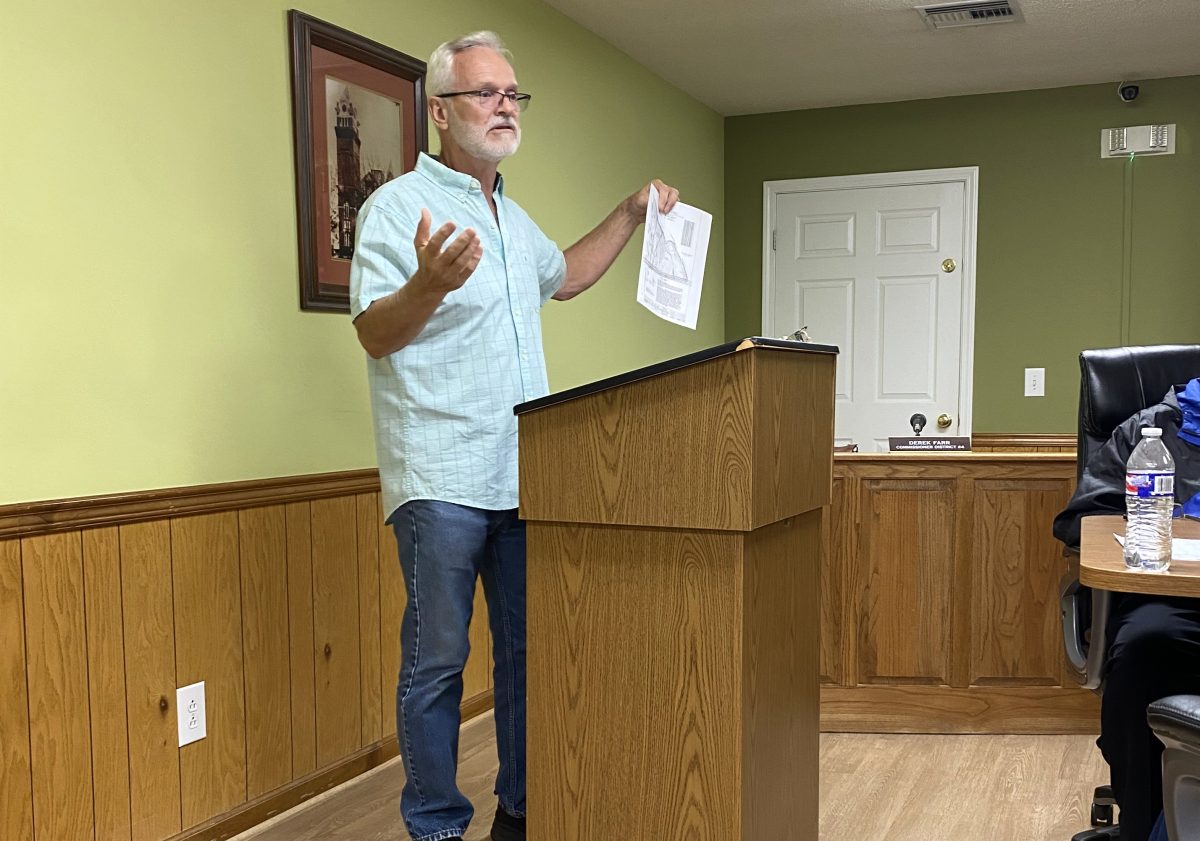
County resident Mike Browning, at last Thursday’s workshop meeting of the Randolph County Commission, pointed out some of the issues with the county’s subdivision policy.
Last Thursday a Randolph County resident stood in front of the Randolph County Commission and posed what, on the surface, is a somewhat simple question.
What is a subdivision?
But the answer to that question, and how the laws governing sub-divided property in Randolph County are enforced, is not quite so simple.
Mike Browning, who lives on County Road 6 in Wedowee and expressed an interest in real estate and property development, came to Thursday’s commission workshop meeting in search of answers.
“My daughter and her husband are looking for properties, possibly to develop, so we’ve been spending a lot of time lately looking at property,” he told the commission, before later adding, “I’m trying to determine what I can build to invest in, and I don’t know what a subdivision is.”
The question is being posed as land throughout the county is being sub-divided, but those changes are not being reported as required, according to Browning.
“It’s happening, and I probably could come up with 10 of them that have shown up in the last six months because there’s something going on,” he said.
Randolph County does indeed have a written policy defining what a subdivision is, how sub-divided properties are to be reported to the county and how the rules regarding subdivisions are to be enforced. The policy is posted on the county’s Highway Department page on its website.
The issue for folks like Browning is the belief that most people who are sub-dividing lots are simply ignoring those rules.

What is a subdivision?
According to the county’s policy a subdivision is any division of one piece of land into two or more lots of 3 acres or less “for the purpose of establishing or creating a subdivision through the sale, lease, or building development of the lot or lots.” This does not apply to property divided between immediate family members.
The county requires such sub-divided lots to be reported to the engineer’s office so that it can be evaluated for compliance. The county would need to verify that each lot has public access for entering and exiting the property and also has access to utilities, among other requirements.
One example given for the reason for this is simple. In the past when some lots were sub-divided, the road to reach one of the lots actually passed through private property. That meant that the owner of that property could gate off the road – because it is not a publicly owned road – causing a significant dispute as to how property owners further up the road would be able to access their property.
A developer who reports their subdivision to the county must also pay inspection fees associated with receiving the county’s approval for a subdivision.
These include:
- A $25 permit fee for the subdivision
- A $250 flat fee, plus $50 per lot for a minor subdivision
- A $500 flat fee, plus $50 per lot for a major subdivision
(A minor subdivision is, in essence, one that is built using existing infrastructure – roads, utilities, etc. A major subdivision is one that requires the construction of that infrastructure.)
According to the policy the county has the authority to impose $1,000 fines for unreported subdivisions, and that amount can be assessed on each lot that is included in the development.
Lack of enforcement
The issue for the county, as in many other areas, is manpower, both in carrying out the specifications of the policy and in enforcing them.
All of the subdivision permits are supposed to flow through the county engineer’s office, and he or his staff would have to conduct all of the policy’s specified inspections.
Likewise, hunting down unreported sub-divided properties can be a tedious task in a rural area. Most, if not all, pieces of land that are surveyed and sub-divided in the county go unreported to the engineer’s office. Enforcement would require tracking down when and where those property changes took place, tracking down the owner, issuing a citation and then assessing the appropriate fine via the sheriff’s department.

A toothless policy?
Browning pointed out that even if the rules were enforced the punishments are not a true deterrent for those skirting the rules.
“You know what? If I’m selling a $250,000 lot I don’t care about a $1,000 fine,” he said. “And I believe that’s the mentality. If I’m selling a $34,000 lot, and I’ve got three of them, and I just bought them for $35,000, what’s a $1,000 fine, even if it’s three of them? What are we doing?”
He also noted what he perceived to be a lack of communication between departments at the county courthouse. When surveys are done in the county, the results of those surveys must be recorded at the courthouse. Browning’s point: Why can’t those recordings be conveyed to the engineer’s office so that the subdivision rules can be applied?
“When that survey was done, they walked across the street [to the county courthouse] and they recorded it,” Browning said. “How difficult would it be for them to say, ‘Wait a minute. This was a lot. It’s now been divided.’”
No clear answer
There appears to be no obvious answer in sight in regards to enforcing the rules that are on the books. New county engineer Chris Gann reported that his department was 13 people short of being fully staffed when he was hired at the start of June. He told the county commission at Monday’s meeting that he had filled five of those positions, but many of those are field positions dedicated to the maintenance and repair of the county’s roadways.
The resources to enforce subdivision rules just aren’t readily available.
It’s a frustrating stalemate for a resident like Browning, who would like to comply with the rules, but sees little motivation for doing so when no one else is being compelled to do so and there are seemingly no consequences for those actions.