Altork: A visit to Birmingham’s nexus of sports and history
PROTECTED CONTENT
If you’re a current subscriber, log in below. If you would like to subscribe, please click the subscribe tab above.
Username and Password Help
Please enter your email and we will send you a password reset link.
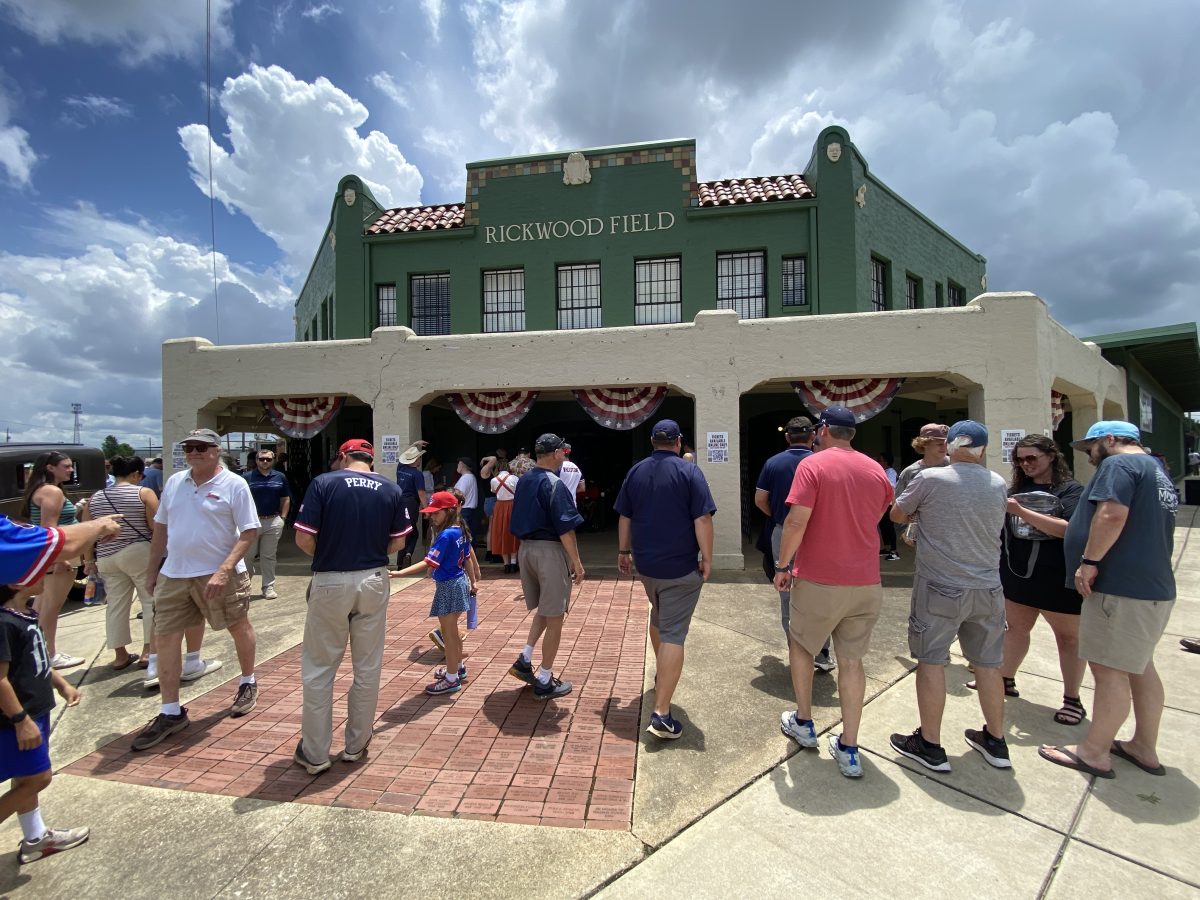
The entryway to Rickwood Field in Birmingham
We all have the subjects in school that become our favorites, and many times some form of those subjects becomes the focal point of our adult lives.
For me, the two topics that always held my attention were sports and history.
I was decent in math and can get caught up in the magic of numbers from time to time, but the subject left me behind when numerical digits gave way to letters and symbols as the primary focus.
I find space fascinating, but the invisible minutiae of science and the incomprehensible vastness of what we don’t know is far too mysterious and open-ended for my tastes.
As much as anything can, sports and history give us determinates.
History is subject to interpretation often times, but at its most basic level it tells us things that have happened, the incontrovertible and unchangeable events that have already taken place.
Sports also exist in definitives. This team won, that team lost. That player is good. This player is bad. It is measured strictly by results, with very little mystery as to what those results actually are.
It’s this intersection of sports and history that makes places like Rickwood Field in Birmingham so doggone fascinating to me.
Rickwood is the oldest standing professional baseball stadium in the country. Older than Fenway. Older than Wrigley. It was built in 1910, and the first game played there was August 18 that year. About a month later, the oldest living American, Naomi Whitehead was born. Which means no American who was alive for the first game at Rickwood is still alive today.
I made my very first visit to Rickwood Wednesday to watch the Birmingham Barons play the Pensacola Blue Wahoos in a AA minor league game. It was perhaps the only baseball game in the thousands that I have attended where the stadium itself was the purpose of my being there, rather than the game.
Rickwood did not disappoint.
Its age is unmistakable, and I mean that in sincere reverence. There’s a saying I heard as a younger adult that has always stuck with me – you can’t meet old friends. The sentiment applies to Rickwood Field – you can’t build an old ballpark.
While the stadium has been modified and updated over the years, there is no mistaking the fact that is 116 years old. There’s wood and cinderblock and brick everywhere, all worn with age. The walkways are narrow, the steps are a little too steep. It still has a hand-operated scoreboard, there’s no video board to be seen, and in between innings the only sound you hear is the murmuring of the crowd and the pop of the mitts on the field as the players warm up.
In an age when modern sports venues feel the need to fill every non-active moment with some sort of assault on the senses, Rickwood is a baseball purist’s dream. The only sound that came out of the speakers was the batters’ names as they came to the plate. In a place like Rickwood you don’t need entertainment between innings. The stage itself is the entertainment.
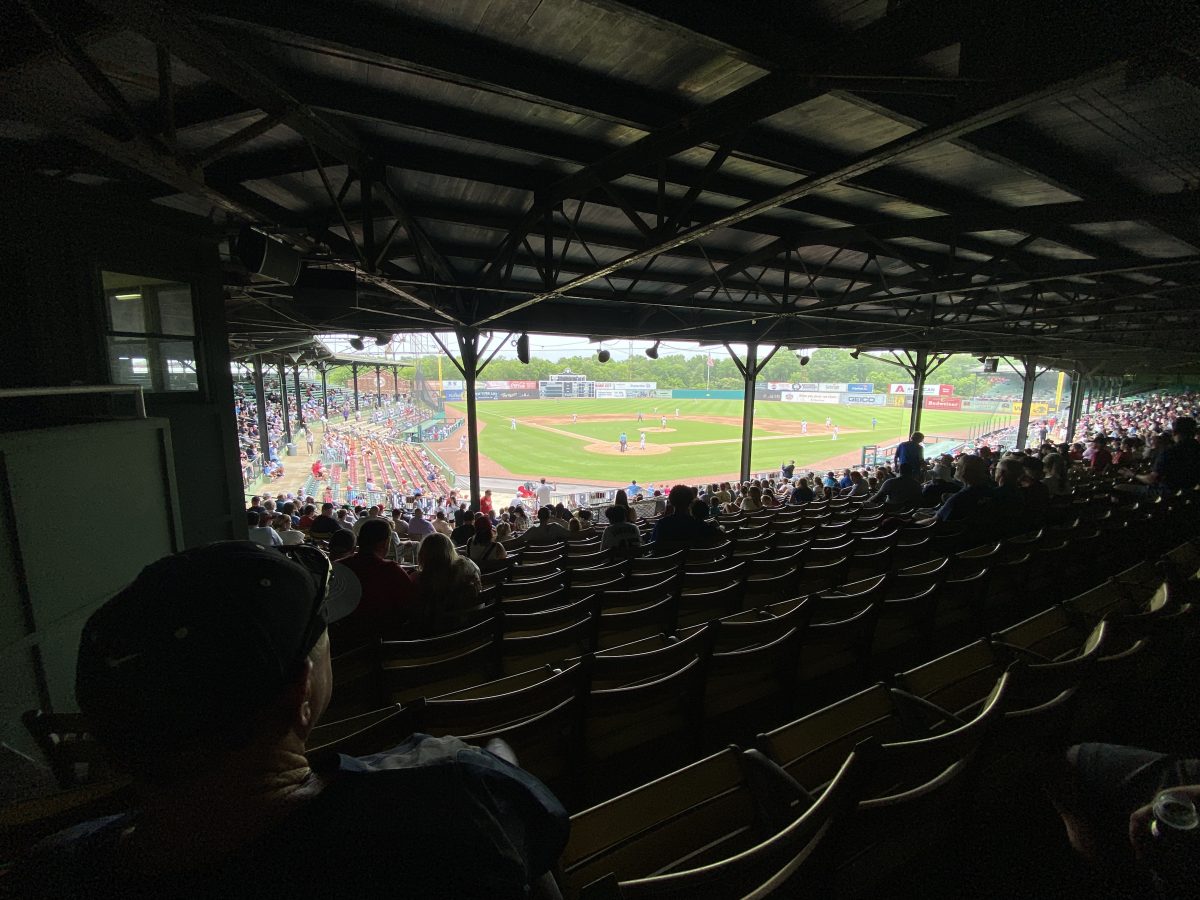
The view from the top of the bleachers behind home plate at Rickwood Field in Birmingham
You feel the age as much as you see it. The ghosts of the players that once stood on that field filled my imagination as I looked out from the bleachers. They say that of the 281 players that are currently in the Major League Baseball Hall of Fame, well over half of them played on that field at one time or another. Names like Willie Mays and Babe Ruth and Hank Aaron and Jackie Robinson and Mickey Mantle.
That’s the part of visiting historical places that always gets me – thinking about the feet that once stood exactly where I am standing and imagining what life was like in that moment.
There are other parts of the park that harken back to the more sinister aspects of life in the 20th century south. The right field seating area is separated from the rest of the bleachers by a gap in the stands. It’s the only such gap in the building, and it’s a somewhat chilling reminder of how the world was built in 1910.
That gap once served as the dividing line between where the white people sat and where the Black people sat. As I walked through that part of the stadium it wasn’t difficult to envision how there would have been a separate entrance there and a partition on the walkway that prevented folks from crossing from one side to the other.
Fortunately those things are long gone, but the structure itself still serves as a reminder of how things once were.
The stadium is both big and small at the same time. Any place that can seat up to 10,000 people is naturally a large structure. But there is nothing grandiose about the entryways. If you only saw the facade outside the main entrance you could easily mistake it for just another small office building.
The way the building is set up, if you were so inclined on the day we were there, you could have easily walked unabated directly from the concourse right into either one of the teams’ dugouts. At some point I’m assuming someone would stop you, but I must admit I had to defeat the temptation to see just how far I could go before that happened.
Nowadays ballparks are built on highways. Back then they were built in neighborhoods. If stadiums wanted to be full for ballgames they needed to be within walking distance of most of the folks who wanted to attend.
As we got near to the stadium on our drive in we noted the decided lack of designated parking places and joked about how there would have been horse troughs and hitching posts to accommodate early 20th century transportation in those first years of the stadium.
Ushers wore bowties, a five-piece jazz band performed behind home plate in between innings, multiple fans sat in their seats with a scorebook on their lap and a pencil in hand, keeping score the way many fans would have done in years past. Some even dressed for the occasion, with a suit and tie and a fedora. I ate two giant hot dogs.
It was an absolute delight, a one-day visit to Birmingham’s one-of-a-kind nexus of sports and history.