Roanoke pursuing funds for infrastructure
PROTECTED CONTENT
If you’re a current subscriber, log in below. If you would like to subscribe, please click the subscribe tab above.
Username and Password Help
Please enter your email and we will send you a password reset link.
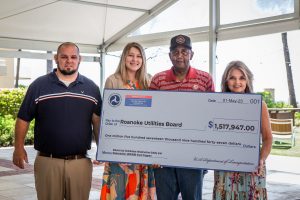
From left, Brian Pilgrim, Cailey Crockett, Ronald Cameron and Pam Bonner all with the Roanoke Utilities Board pose with a check for gas line improvements.
Roanoke’s infrastructure will be the beneficiary of one significant grant, while the city took action Monday to pursue money for another grant.
The Roanoke Utilities Board was awarded federal grant money in the amount of $1.5 million to replace an aging gas line that runs into the north end of town from underneath Highway 431.
Utilities Board member (and Roanoke Fire Chief) Ronald Cameron told the Roanoke City Council Monday that the board was awarded the grant last week in its second attempt to secure the funds.
The gas line in question runs from County Road 61 just north of Walker’s Service Station, goes along 431 and then follows North Main Street past the Roanoke Rural Health Clinic.
The Utilities Board had been given a five-year window to either replace the line or shut it down. Cameron said that at the time the grant was awarded they were two years away from that deadline.
Cameron told the council it would be about a year before the work can begin on the gas line.
Meanwhile, in other action Monday, the council unanimously agreed to pursue grant funds that would allow the city to update several sidewalks around town.
The city is facing a May 31 deadline to apply for grant money up to $800,000 that could be used for the projects.
During the meeting the council discussed which streets should be prioritized for the sidewalk work That discussion included Chestnut Street, which council member Tammi Holley has made repeated inquiries about over the past year. It also included West Point Street on the back side of Handley High School, where a young girl was hit by a car shortly after Christmas last year. The council also sought to include College Street and Cannon Street with the idea of accommodating foot traffic heading from the surrounding neighborhoods to Handley High School.
Those projects would most likely not come close to the $800,000 maximum for the grant being pursued, but would probably fall somewhere between $100,000 and $200,000.
If the city is awarded the grant it would have to provide 20 percent matching funds, which would essentially give the city the ability to fix or build five sidewalks for the price of one.
Related Posts


Huey: Debunking the mystique of the Bermuda Triangle


New county engineer Chris Gann on the job